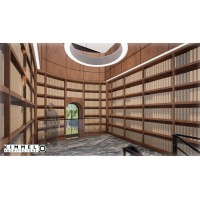
Iconic Saint Vincent landmark to be reborn as Latimer Library Tower
LATROBE, PA – Sauerkraut Tower, an iconic Saint Vincent landmark and former water tower, will soon be reborn as the new Latimer Library Tower thanks to a $3.5 million renovation and expansion project.
The initiative, expected to be underway during the summer, will transform the historic Tower into a modern addition to the Dale P. Latimer Library.
A two-story addition connecting to the west side of the original Tower will feature a first-floor lobby and restroom and a second-floor research space.
Plans include a public gallery and exhibition space to showcase artwork, historical documents and other artifacts; an area for research with access to special collections; and a stairway leading up to a third-floor balcony-level reading room.
“This third concurrent building project at Saint Vincent College is a testament to the growth and strength of our college. Because of its unique designation as an historic, adaptive-reuse renovation, this building will serve as a reminder that Benedictines are not prisoners of the past, but rather build a new future based upon the foundation of history,” said Father Paul Taylor, O.S.B., C’87, S’91, PhD, president of Saint Vincent College. “The Latimer Library Tower will be yet one more tranquil space on campus for students, faculty and others for intense study and quiet reflection. We offer gratitude to those who believe in our mission and support this important project.”
Rt. Rev. Martin de Porres Bartel, O.S.B., S’85, archabbot of Saint Vincent Archabbey and chancellor of Saint Vincent College, called the renovation a quintessential Benedictine undertaking, noting that since the sixth century, monasteries have housed libraries and scriptoria where monks copied and illuminated texts bearing the wisdom of the ages.
“The monastery founded by Saint Benedict at Monte Cassino in 529 became one of medieval Italy’s most influential ‘publishers,’ sustaining Western civilization through its darkest hours,” he said. “Saint Vincent is privileged to continue this noble tradition.”
The Tower’s adaptive reuse, Archabbot Martin added, embodies the Benedictine stewardship described in “The Rule of Saint Benedict”: “[He] will regard all utensils and goods of the monastery as sacred vessels of the altar, aware that nothing is to be neglected” (31:10–11).
“This principle underpins our preservation of this historic and architectural asset as a revitalized resource for the Saint Vincent community,” Archabbot Martin said.
The brick structure was designed by Brother Wolfgang Traxler and constructed in 1893 using monk-made bricks. It originally served as a gravity-powered water distribution method for the campus, likely utilizing an underground water cistern buried along the east side of the Tower.
Original blueprints for the Tower, unearthed by Guy Davis, who serves as the College’s archivist and collections coordinator, show two oak tanks measuring 16 feet in diameter housed inside. Each tank held 20,000 gallons of water. As the campus and needs expanded, three additional tanks measuring 12 feet in diameter were installed and housed in a wooden addition that was likely added in the early 20th century atop the Tower. Each tank likely held roughly 13,000 gallons of water. The Tower supplied the campus with water up until 1974, and the top-level addition was likely removed in the 1990s.
“By that time (1970s), the buildings were more numerous, and even though they were gravity fed, it was getting harder and harder for the water supply to reach the upper floors because there were so many buildings now,” Davis said.
Due to its consistently cool interior, the Tower was at one point adapted as storage for cabbage by the Benedictine nuns from Abtei Saint Walburg in Eichstätt, Germany, who for decades provided meals for the campus community.
“We’re recycling something, which is very important in Benedictine values, utilizing what God has given us and preserving the Saint Vincent heritage,” Davis said. “I think it’s great to use again and it’ll be an attraction for campus.”
The project is funded in part by the Commonwealth of Pennsylvania, which has authorized a $1 million grant from the Redevelopment Assistance Capital Program. In addition to the grant, funding has been provided by a host of alumni, friends and foundations.